

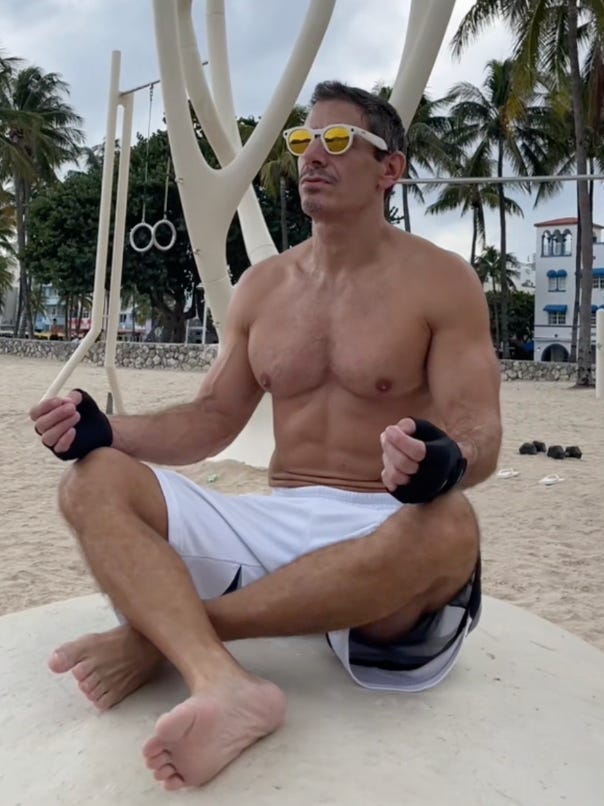
The year was 1990, and I was struggling in my first trimester of chiropractic school.
So I debated whether to invest in a meditation course offered by another student.
Mr. Skeptical folds his arms and sighs. “So this is where you became enlightened?”
I’ll be having a LIVE Zoom LinkedIn webinar on “Is diabetes reversible?” on Wednesday, February 25th, at 5 pm. Click here for details.
Subconscious Fat at 30,000 feet
No, not enlightened, but I needed something to ease my stress after getting into chiropractic school.
I was only 20 years old, the 2nd youngest in my class.
I was extremely stressed taking on so many courses.
We would be in school from 7:30 am till usually 5 pm each day.
Mr. Skeptical adds, “That sounds worse than a sucky job.”
It was.
I remember I even had high blood pressure back then, I was 130 over 90 or more typically.
I once felt a tingling sensation in my left arm, and I thought I was having a heart attack.
Mr. Skeptical laughs. “Well, you’re still here.”
I glare at him.
Yeah, sorry to disappoint you.
Subconscious Fat at 10,000 feet
This older student had convinced a few of his classmates and me to join him for a transcendental meditation course.
He gave two classes for free and then said if you want to continue, you needed to pay $150.00
Mr. Skeptical looks up and to the right, eyes narrowing slightly — the universal sign that a mental recalibration is underway.
“Selling meditation to stressed-out students… yeah, that’s a reliable revenue stream if I’ve ever seen one.”
Well, I needed help.
I felt like this could be the lifeline I needed, keeping me from sinking below the surface.
He smiles. “So you got suckered into it, didn’t you?”
My jaw clenches as Mr. Skeptical reminds me of a fellow student from back then.
Subconscious Fat at Eye-Level
I fix Mr. Skeptical with a look.
You’re totally reminding me of a student back then with the last name of McAllister.
“I’m guessing he was a smart guy who never paid the $150.”
Yep, he not only didn’t pay but also called me an idiot for paying.
Mr. Skeptical lifts a hand halfway, the universal gesture for “you know I’m right on this one.”
“I would’ve totally agreed with him.”
He even had a transcendental meditation book — and he seemed personally committed to reminding me that I’d paid $150 for what he got for the price of a paperback.
Mr. Skeptical lifts an eyebrow.
“So why not just buy the book and save the money?”
I pause for a moment.
Because on paper, his logic is airtight.
Because I didn’t want another book, I explain. I was already buried in textbooks. I didn’t need more information — I needed an experience.
Mr. Skeptical leans back, processing that distinction.
“But still,” he presses, “$150… for something you could’ve learned cheaper?”
“Maybe cheaper,” I say. “But not deeper.”
He narrows his eyes slightly.
“What do you mean?”
Practical Suggestions and Conclusions
When you pay for something, I explain, “you show up differently. You listen differently. You take it seriously. You don’t treat it like optional reading.
Mr. Skeptical looks up, thinking — the quiet recalibration beginning.
“So you’re saying the money changed the outcome?”
Exactly.
I continue:
That course helped me manage stress when I was overwhelmed in school. It wasn’t just the content — it was the structure, the environment, the commitment.
If I’d bought the book, I add, it probably would’ve sat on a shelf with the rest of my good intentions.
Mr. Skeptical exhales slowly.
“So the investment forced the engagement.”
I nod.
And the engagement produced the benefit.
He stares into the middle distance for a moment — the look of someone realizing this applies far beyond meditation courses.
“You know,” he admits, “people always say they want change… but they usually want it discounted.”
I smile again.
And discounted commitment tends to produce discounted results.
Mr. Skeptical nods reluctantly.
“So the more you invest in yourself…”
The more seriously you treat the process, I finish, and the more you tend to get out of it.
And that’s the quiet part most people overlook.
Information is everywhere.
Access is cheap.
Advice is abundant.
But transformation tends to follow commitment — not convenience.
The more deliberately people invest in themselves…
…the more seriously they engage with the process.
And engagement — more often than not — is what drives results.
Be aware.
Other links related to this post:

When I was my Fattest

Jumping Off Haulover Bridge

E-Bike AccidentPS Links on LinkedIn, Facebook, Instagram, X, and Notes. Full disclosure: ChatGPT was used to research and enhance this post.
PSS LIVE Zoom LinkedIn webinar on “Is diabetes reversible?” on Wednesday, February 25th, at 5 pm. Click here for details.