

Subconscious Fat at 30,000 feet
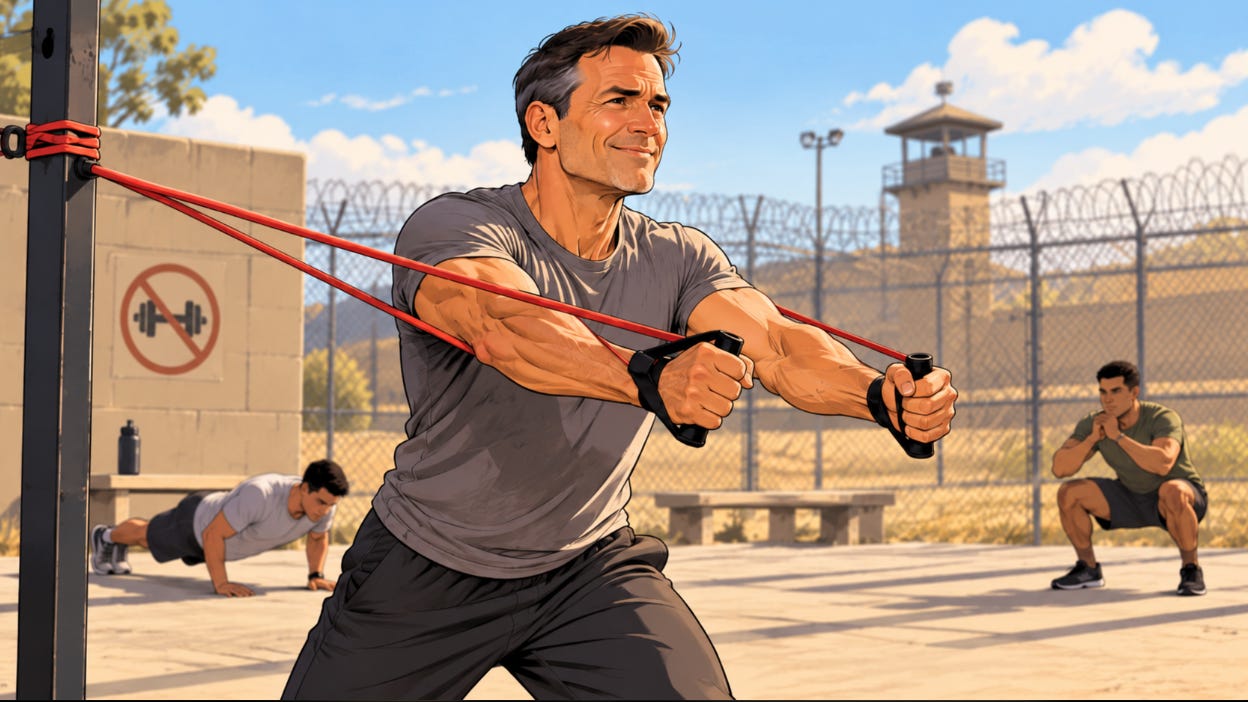
I learned one of my most valuable fitness lessons in a place most people wouldn’t associate with getting healthy: federal prison.
Yes, you read that correctly.
I spent time in federal prison, and during that experience, I discovered something that would eventually become a cornerstone of my fitness philosophy. (If you want to know why I ended up in federal prison, read the link below: From Chiropractor to Fitness Trainer.)
You don’t need a gym full of expensive equipment to build a strong, muscular body.
Back in 1996, Congress prohibited the use of federal funds to provide bodybuilding and weightlifting equipment for federal prisoners. Some prisons retained older equipment, but purchasing new weights with federal funds was prohibited.
I was housed in federal prison camps, where traditional weights weren’t available.
So we improvised.
Push-ups. Pull-ups (often done in bathroom stalls, because pull-up bars weren’t around). Air squats. And resistance bands that people managed to sneak into the camps.
We even did our own version of CrossFit.
Nothing fancy. No expensive machines. No shiny chrome-plated dumbbells.
And guess what?
We got some pretty damn good workouts.
Mr. Skeptical raises an eyebrow.
“So your fitness philosophy started in prison? That’s certainly not something they teach at personal training school.”
No, they don’t. And as it turns out, there are quite a few things they don’t teach you.

This Friday on The Better Wealth and Health Podcast, I stand up with Geoffrey Kent, a Philadelphia-based entrepreneur, business strategist, and educator with more than 40 years of experience building, scaling, and leading businesses. A graduate of the Wharton School, Geoffrey is the founder of Think Big with Geoffrey Kent, where he helps aspiring and established entrepreneurs turn their ideas into successful, scalable businesses. Through his educational programs and coaching, he shares practical strategies for entrepreneurship, business growth, and long-term wealth creation. You can find him on LinkedIn.
🎙️ Watch for the full episode dropping tomorrow, Friday at 11:57 a.m. ET
Subconscious Fat at 10,000 feet
While incarcerated, I frequently did CrossFit-style workouts alongside guys considerably younger than me.
Now, I’ve always been competitive. Sometimes too competitive for my own good.
When a guy 20 years younger was pushing harder, my natural instinct was to keep up.
The problem?
My competitive spirit didn’t always agree with my joints.
I’d push too hard, end up hurting myself, and occasionally pay the price for days afterward.
But when I trained with resistance bands, something was different.
I could challenge my muscles tremendously without needing heavy barbells or dumbbells.
I began appreciating just how effective such a simple piece of equipment could be.
That experience took on even greater significance because I’d spent 22 years practicing as a chiropractor.
I’d seen plenty of men over 40 injure themselves in gyms, often through poor technique, inappropriate loads, or simply trying to lift more than their bodies were prepared to handle.
Later, while studying for my personal training certification, I noticed how little attention my coursework devoted to resistance bands.
The fitness industry is heavily centered around gyms, equipment, and memberships.
There’s nothing inherently wrong with that. Conventional weight-training equipment works extremely well.
But there’s a misconception that you need sophisticated machines or heavy weights to achieve meaningful results.
You don’t.
Mr. Skeptical interrupts.
“Wait a minute. Are you telling me a rubber band can replace thousands of dollars’ worth of gym equipment?”
For many muscle-building and strength-training goals, absolutely.
In fact, a 2019 systematic review and meta-analysis found that elastic resistance training produced strength gains comparable to conventional resistance equipment.
The muscles don’t care how expensive your equipment is.
They respond to appropriately challenging resistance.
Subconscious Fat at Eye-Level
Now let’s talk about one of my favorite advantages of resistance bands.
Variable resistance.
When you stretch a resistance band, the tension generally increases.
The farther you stretch it, the greater the resistance.
That’s different from a conventional dumbbell, whose weight remains essentially constant throughout the movement.
Depending on the exercise, increasing resistance as you approach the end of a repetition can complement your body’s changing mechanical leverage.
Here’s one of my favorite examples: the band crossover chest press.
Place a resistance band around your upper back, underneath your deltoids. Bring your arms forward and across your body, contracting your chest.
As you push forward, resistance increases.
Now here’s where things get interesting.
I’ll sometimes perform a challenging set until I reach momentary muscular failure—the point where I can no longer complete another full repetition with proper technique.
But that doesn’t necessarily mean the muscle is incapable of doing anything else.
I can still perform controlled partial repetitions.

By continuing through the range of motion, I can extend the set and create additional muscular work.
Research on partial repetitions after muscular failure has shown promising results.
Mr. Skeptical jumps in.
“So you’re saying I can keep exercising even after I can’t complete another repetition?”
Yes, when using resistance bands.
But there’s an important difference between controlled partial repetitions and simply flailing your arms around like you’re trying to escape a swarm of mosquitoes.
Technique matters. Joint comfort matters. With bands, you can reach muscle failure safely without a spotter, unlike with free weights.
Practical Suggestions and Conclusions
So what does all this mean if you’re a man over 40 who wants to get leaner, stronger, and more muscular without spending hours in the gym?
First, stop assuming that heavier equipment automatically produces better results.
Progressive resistance, proper technique, consistency, and recovery matter much more than how impressive your equipment looks.
Second, consider incorporating resistance bands into your routine.
You can effectively train your chest, back, shoulders, arms, and legs using a remarkably small amount of equipment.
Third, learn to challenge your muscles rather than simply moving weight from point A to point B.
With a band, start with controlled, full-range repetitions, keep going to muscle failure, and do as many partial repetitions as you can.
And finally, remember that recovery becomes increasingly important as we age.
Between my experience as a chiropractor, my competitive nature during those prison workouts, and my years of experimenting with resistance training, I’ve learned one important lesson:
The smartest workout isn’t necessarily the one that leaves you completely destroyed.
It’s the one that produces results while allowing you to return and train consistently.
Mr. Skeptical raises his finger to ask another question.
“So you’re telling me I don’t need an expensive gym membership, fancy machines, or an hour every day?”
That’s precisely what I’m telling you.
At Occam’s Razor Fitness, I emphasize brief, effective workouts using resistance bands and body weight.
Just 10 focused minutes a day can be a practical starting point for developing better exercise habits, improving strength, and building a healthier body.
My training philosophy wasn’t born in some fancy gym or high-priced personal training seminar.
It was born out of necessity in federal prison, refined through experience, and reinforced by science.
Sometimes the simplest solution is hiding in plain sight.
And sometimes it comes in the form of a rubber band.
Be aware.
Other links related to this post:
PS Links on LinkedIn, Facebook, Instagram, X, and Notes.
Full disclosure: ChatGPT was used to research and enhance this post.
🎙️ The Better Wealth & Health Podcast with guest Geoffrey Kent drops tomorrow at 11:57 AM Eastern.