

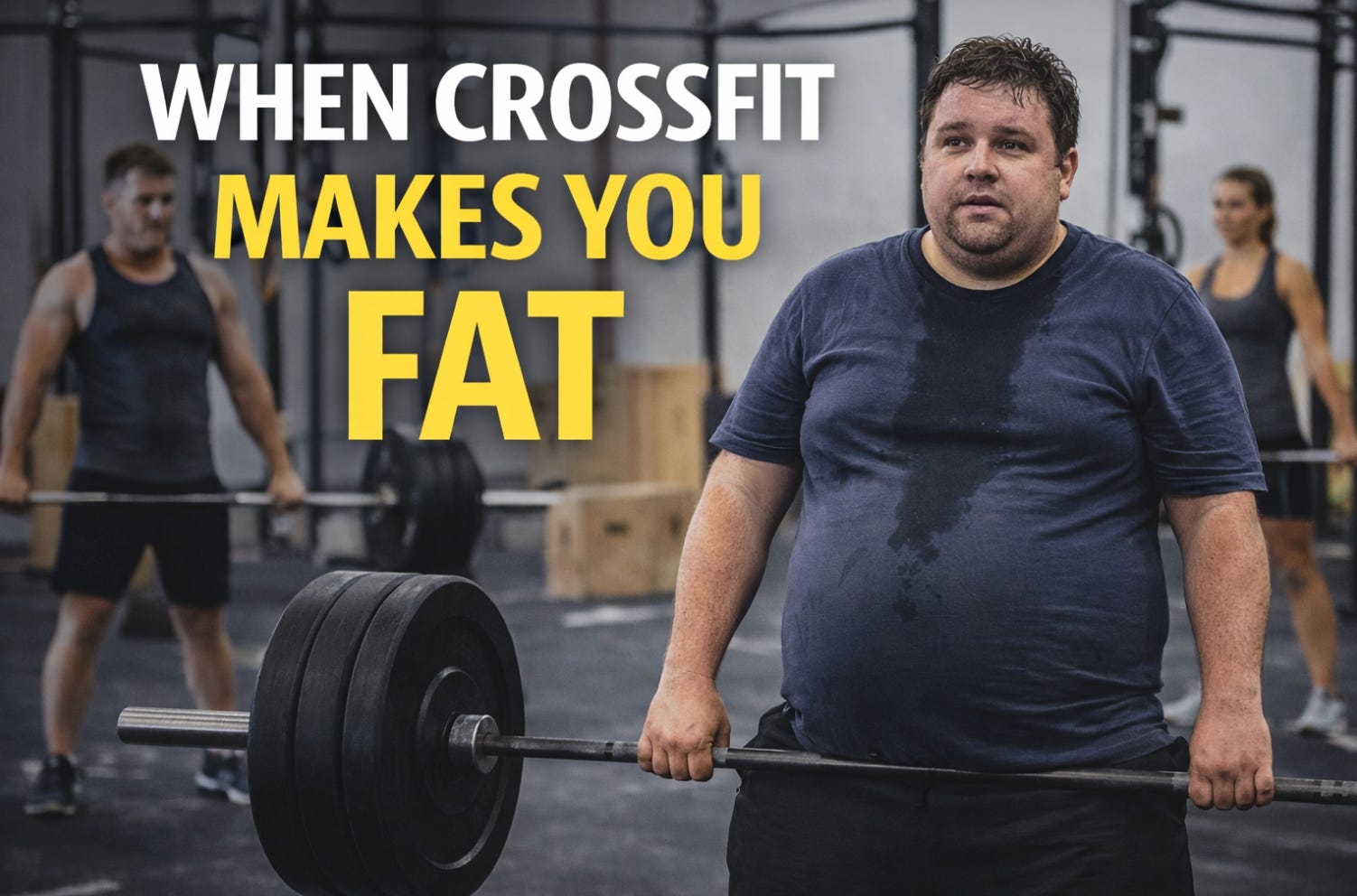
Subconscious Fat at 30,000 feet
I remember standing at a holiday gathering — one of those Thanksgiving-Christmas hybrid get-togethers where the food table stretches longer than the dining table itself.
Turkey.
Stuffing.
Pies.
Alcohol.
Carbs layered on carbs.
And across the room was a guy I hadn’t seen in a while.
Big guy.
Not obese… but clearly carrying significant body fat.
Belly pushing against his shirt.
Love handles visible from behind.
Face slightly puffy.
We started talking, catching up.
And somewhere in the conversation, he said something that stopped me cold.
He told me he was doing CrossFit…
Five to six times a week.
Mr. Skeptical leans in, already smirking.
“Wait… the intense, puke-bucket, sweat-on-the-floor CrossFit?”
Exactly.
High-intensity.
Heavy lifts.
Metabolic conditioning.
Constant fatigue.
And yet… he looked metabolically unchanged.
If anything, he looked heavier than the last time I saw him.
Which raises an uncomfortable but important question:
How is it possible to train that hard… and still gain fat?
Subconscious Fat at 10,000 feet
On the surface, it doesn’t make sense.
CrossFit burns massive calories.
It elevates heart rate.
Builds muscle.
Pushes metabolic output.
So logically, fat loss should follow.
But metabolism isn’t just about output.
It’s also about input.
And more importantly — appetite signaling.
High-intensity training stimulates hunger hormones, particularly ghrelin — the body’s primary hunger signal.
The harder you train…
The louder that signal becomes.
Mr. Skeptical raises an eyebrow.
“So the workout that’s supposed to make you lean… makes you hungrier?”
Exactly.
Your body interprets repeated high-output training as a survival demand.
So it compensates:
Increased hunger
Increased cravings
Increased calorie drive
Now add modern food availability to that equation…
And things get interesting.
Subconscious Fat at Eye-Level
Because here’s what often happens in the real world.
Someone does brutal training 5 or 6 days a week.
They leave the gym exhausted.
Starving.
Depleted.
And then they reward themselves nutritionally like they just ran an Ironman.
Carbohydrates spike.
Sugary “recovery” drinks.
Protein bars loaded with sweeteners.
Pizza nights with the gym crew.
Weekend binge eating justified by weekday suffering.
Mr. Skeptical crosses his arms.
“So they out-train their discipline… but not their appetite?”
That’s the paradox.
You can increase metabolic output dramatically…
But if calorie intake — especially from high-glycemic carbohydrates — rises even faster…
Fat storage still occurs.
Because insulin remains elevated.
And elevated insulin favors storage, not mobilization.
So despite enormous physical effort…
Body composition stagnates — or worsens.
Practical Suggestions and Conclusions
This is where one of the oldest fitness truths becomes unavoidable:
You cannot out-exercise a bad diet.
No volume of burpees…
No number of WODs…
No amount of Olympic lifting circuits…
Overrides consistent caloric surplus — especially from hyper-palatable, high-carbohydrate foods.
Mr. Skeptical tilts his head.
“So CrossFit doesn’t make people fat… eating like a CrossFitter can?”
Precisely.
The training isn’t the problem.
The metabolic compensation is.
High-output exercise increases:
Ghrelin (hunger hormone)
Appetite signaling
Reward-driven eating
Caloric justification behavior
If nutrition isn’t structured intentionally…
The body refuels — and often over-refuels.
Which is why some of the leanest physiques you’ll ever see…
Aren’t built on maximal exercise volume.
They’re built on nutritional control paired with intelligent training.
Because fat loss isn’t just about burning calories…
It’s about managing hormonal environment, appetite signaling, and metabolic inputs.
The man I saw at that holiday gathering wasn’t lazy.
He wasn’t undisciplined in the gym.
If anything, he was over-disciplined physically.
But metabolically?
He was unknowingly compensating.
Training like an athlete…
Eating like a survivor.
And storing like a body trying to protect itself.
Sometimes the subconscious fat mechanism isn’t inactivity…
It’s the belief that effort alone overrides intake.
And until that belief shifts…
Even the hardest workouts can coexist with expanding waistlines.
Be aware.
Other links related to this post:
Can Cardio Workouts Make You Gain Weight?
PS Links on LinkedIn, Facebook, Instagram, X, and Notes. Full disclosure: ChatGPT was used to research and enhance this post.