

Subconscious Fat at 30,000 feet
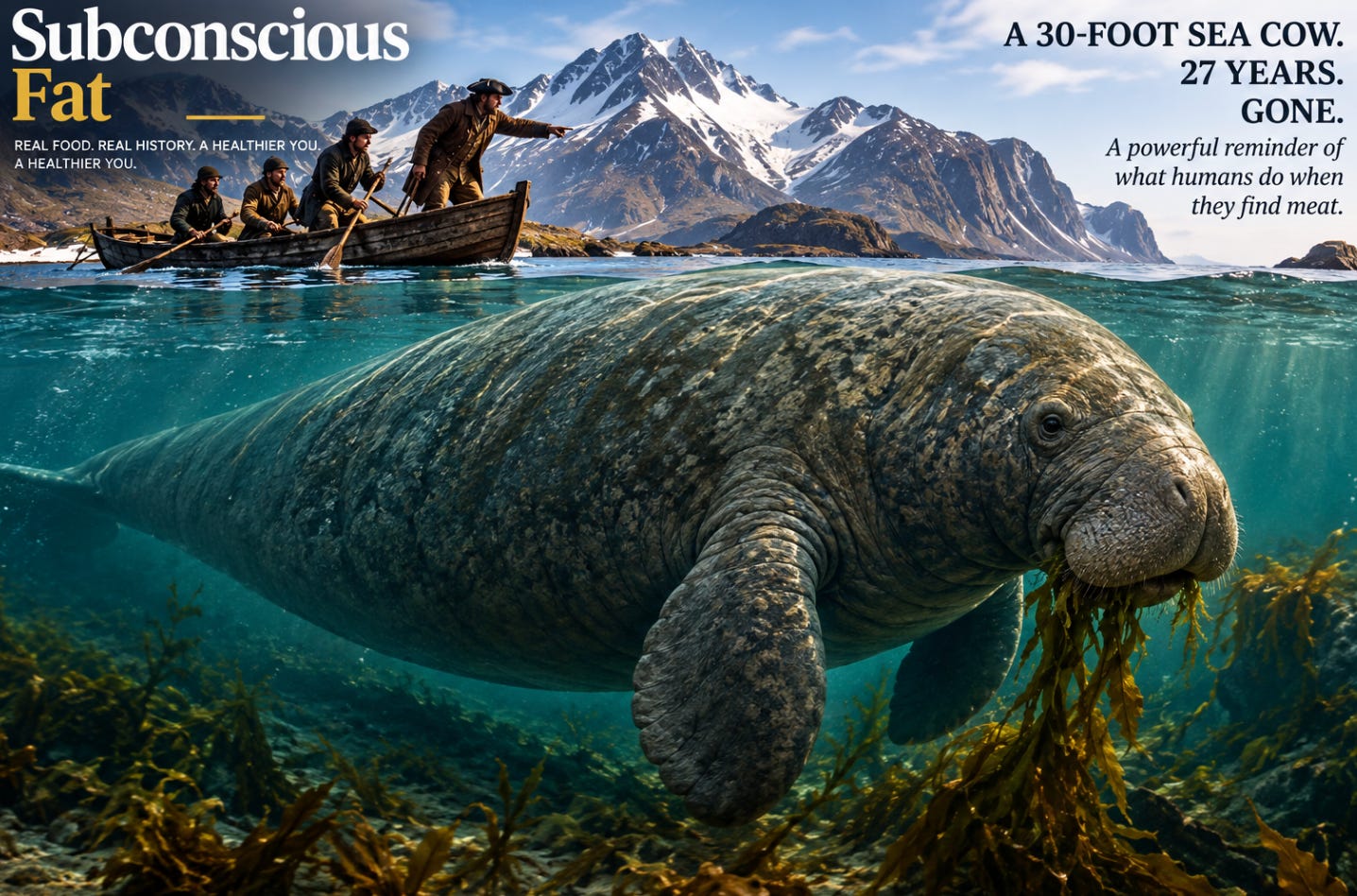
Imagine you’re a sailor in 1741.
You’re cold. You’re hungry. You’re stranded in the North Pacific.
Then you look into the shallow water and see something that shouldn’t exist.
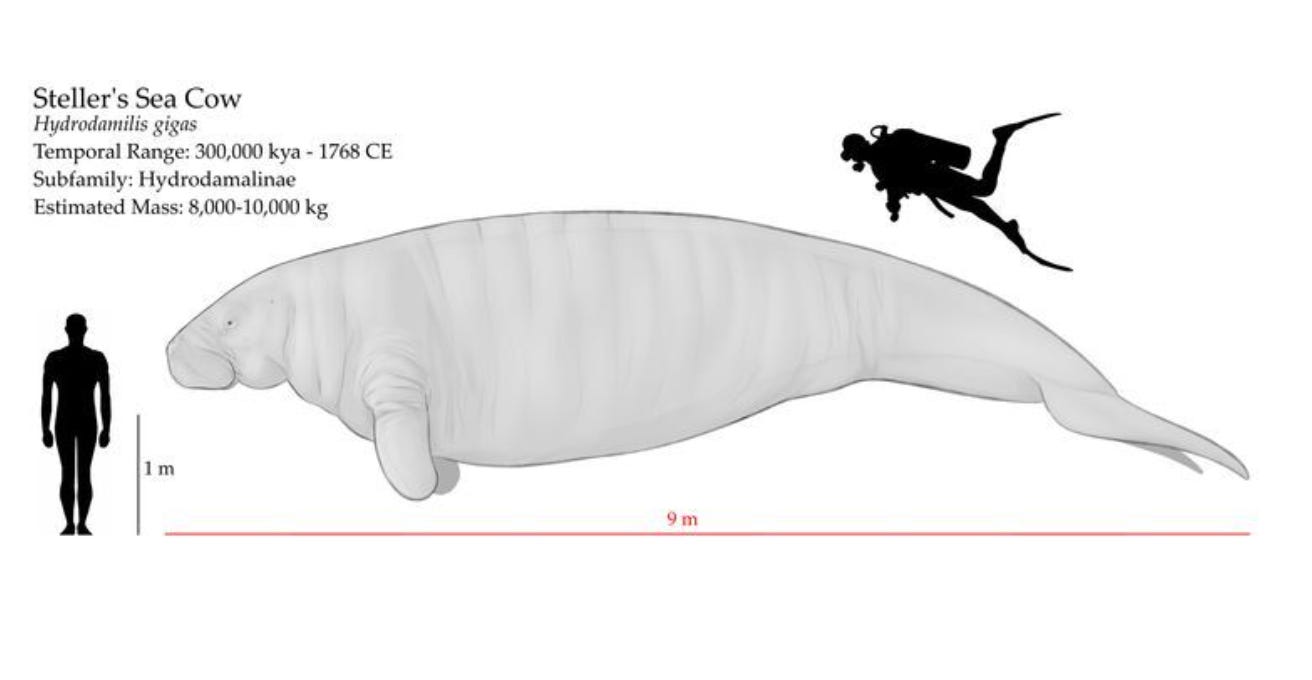
A 30-foot, multi-ton sea cow slowly grazing on kelp.
No supermarket. No nutrition label. No influencer telling you whether it’s “heart healthy.”
You see food.
Mr. Skeptical interrupts.
“Wait. You’re telling me people discovered a completely unfamiliar 10-ton sea monster and their first thought was… dinner?”
Pretty much. Here I disagree with ChatGPT; a hungry human, for sure, would be thinking about it when seeing a large, defenseless animal.
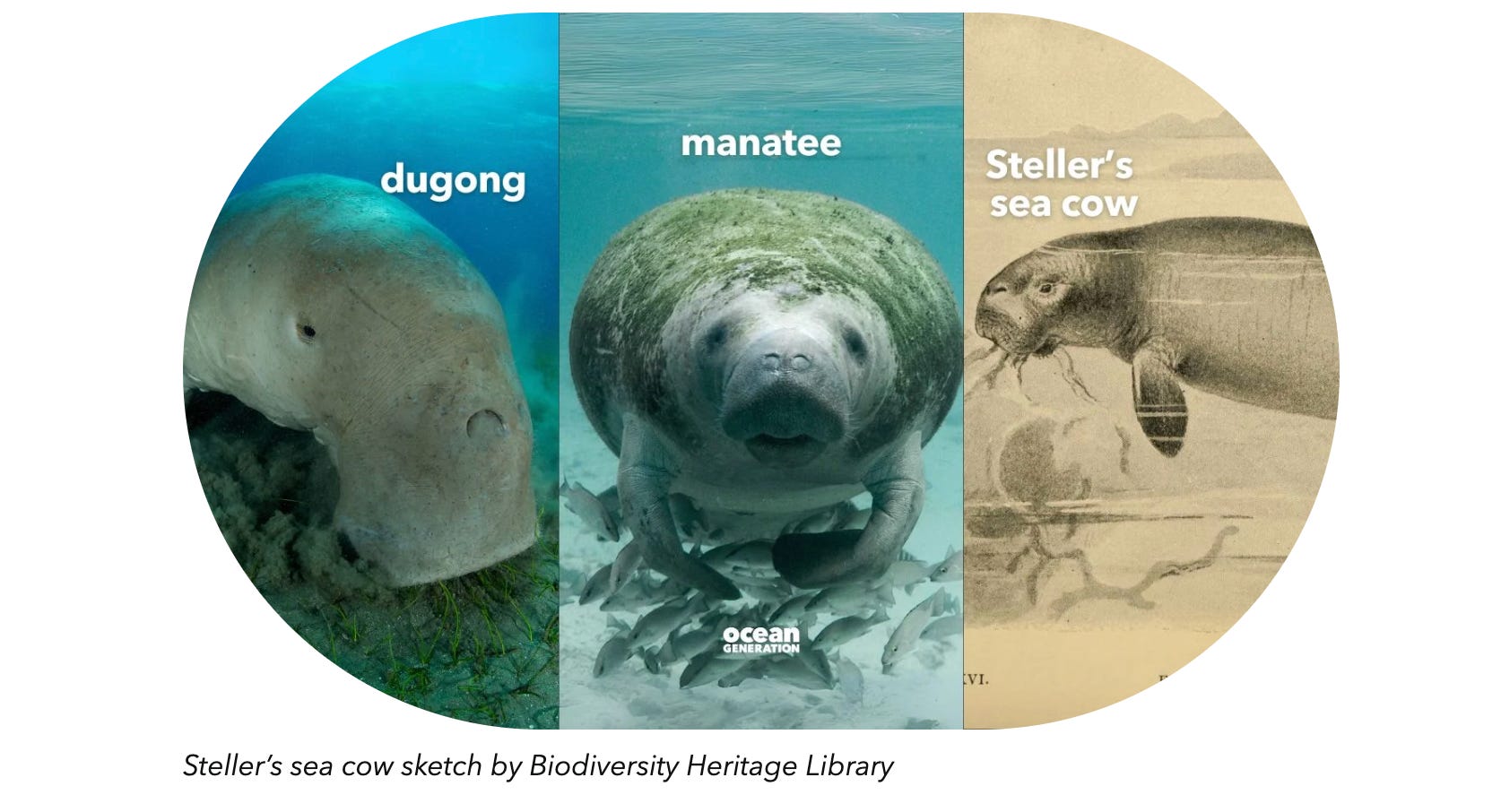
It was called Steller’s sea cow, a gigantic relative of today’s manatees and dugongs. Europeans encountered it around the Commander Islands in 1741.
By 1768, it was extinct.
Twenty-seven years.
Humans arrived, discovered it, and hunted it relentlessly for its meat and fat.
Mr. Skeptical smiles.
“Wow. What an impressive conservation strategy.”
Ugh. His sarcasm is unbearable.
But Mr. Skeptical has a point.
We discovered one of the largest marine mammals on Earth—and within 27 years, it was gone.
It’s a conservation tragedy.
But it also tells us something fascinating about humans and food.
Subconscious Fat at 10,000 feet
For most of human history, eating wasn’t an intellectual exercise.
It was survival.
Our ancestors didn’t ask whether an animal was familiar.
They asked whether they could catch it.
Wild horses are another fascinating example.
Long before horses became symbols of transportation, warfare, and cowboy movies, humans hunted them for food. Archaeological evidence shows wild-horse hunting stretching deep into the Paleolithic, including sites where entire groups of horses appear to have been systematically harvested.
Eventually, our relationship with horses changed dramatically. Humans managed them, milked them, harnessed them, and ultimately rode them.
Mr. Skeptical raises an eyebrow.
“So before Uber, the horse was basically lunch?
Yes, it was.
And consider the dodo.
When European sailors reached Mauritius, they encountered a large flightless bird that had evolved without fear of humans.
Humans hunted it for food. But here’s where the popular story needs correcting: we didn’t simply eat every last dodo. Introduced pigs, rats, dogs, and cats also devastated the birds and their eggs.
Still, within roughly a century of European arrival, the dodo was gone.
Subconscious Fat at Eye-Level
There’s a pattern here.
Humans have an extraordinarily long relationship with animal foods.
Different environments produced different menus: fish near coastlines, horses on Eurasian grasslands, large mammals where they were available, and eventually domesticated cattle, sheep, goats, and pigs.
Mr. Skeptical interrupts again.
“Okay, cavemen ate meat. Why should I care what somebody ate 20,000 years ago? I’ve got Whole Foods.”
Fair question.
Our evolutionary history doesn’t prove that everybody today should eat an all-meat diet.
But it does demolish the idea that meat is some strange modern addition to the human diet.
Animal foods aren’t new.
They’re ancient.
Humans have sought them out across radically different environments and cultures for an extraordinarily long time.
The stranger story might actually be how recently we’ve begun debating whether eating animals is somehow unnatural for humans.
Practical Suggestions and Conclusions
I’m certainly not suggesting we repeat the Steller’s sea cow experiment.
Quite the opposite.
We managed to discover one of the most extraordinary marine mammals ever documented and eliminate it within 27 years.
That’s not nutritional wisdom.
That’s a lesson in what happens when consumption outruns conservation.
But there’s another lesson buried inside the story.
For our ancestors, meat wasn’t something that came shrink-wrapped with a barcode.
It was valuable nutrition that had to be hunted, caught, butchered, shared, and preserved.
Mr. Skeptical leans back.
“So you’re saying eat the steak… just don’t wipe out the species?”
Now you’re getting it.
I favor a meat-centered diet because foods such as beef, eggs, fish, and other animal products provide abundant protein and important micronutrients in highly concentrated packages.
But you don’t need to exaggerate history to make that case.
The real history is fascinating enough.
For hundreds of thousands of years, humans and our ancestors have pursued animals for food.
The animals changed.
The hunting methods changed.
Eventually the spear became the supermarket.
But meat never stopped being food.
And perhaps the strangest chapter isn’t that humans once looked at a gigantic sea cow and thought:
“Can we eat that?”
ChatGPT, put in the previous comment, but I think the comment is making humans look nicer than we really are. I’d argue a hungry human back then thought ‘How do we kill it right away.’
The silly thing is, today, surrounded by foods our ancestors would barely recognize, we’re suddenly asking whether eating animals was ever natural in the first place.
But you know better now; don’t fall for the bullshit.
Be aware.
Other links related to this post:
PS Links on LinkedIn, Facebook, Instagram, X, and Notes.
Full disclosure: ChatGPT was used to research and enhance this post.
Doing a live banded workout event on Saturday, October 3rd at Legions Park in Miami, details coming soon.