

Subconscious Fat at 30,000 feet
Modern obesity is not just about overeating.
It is about perception.
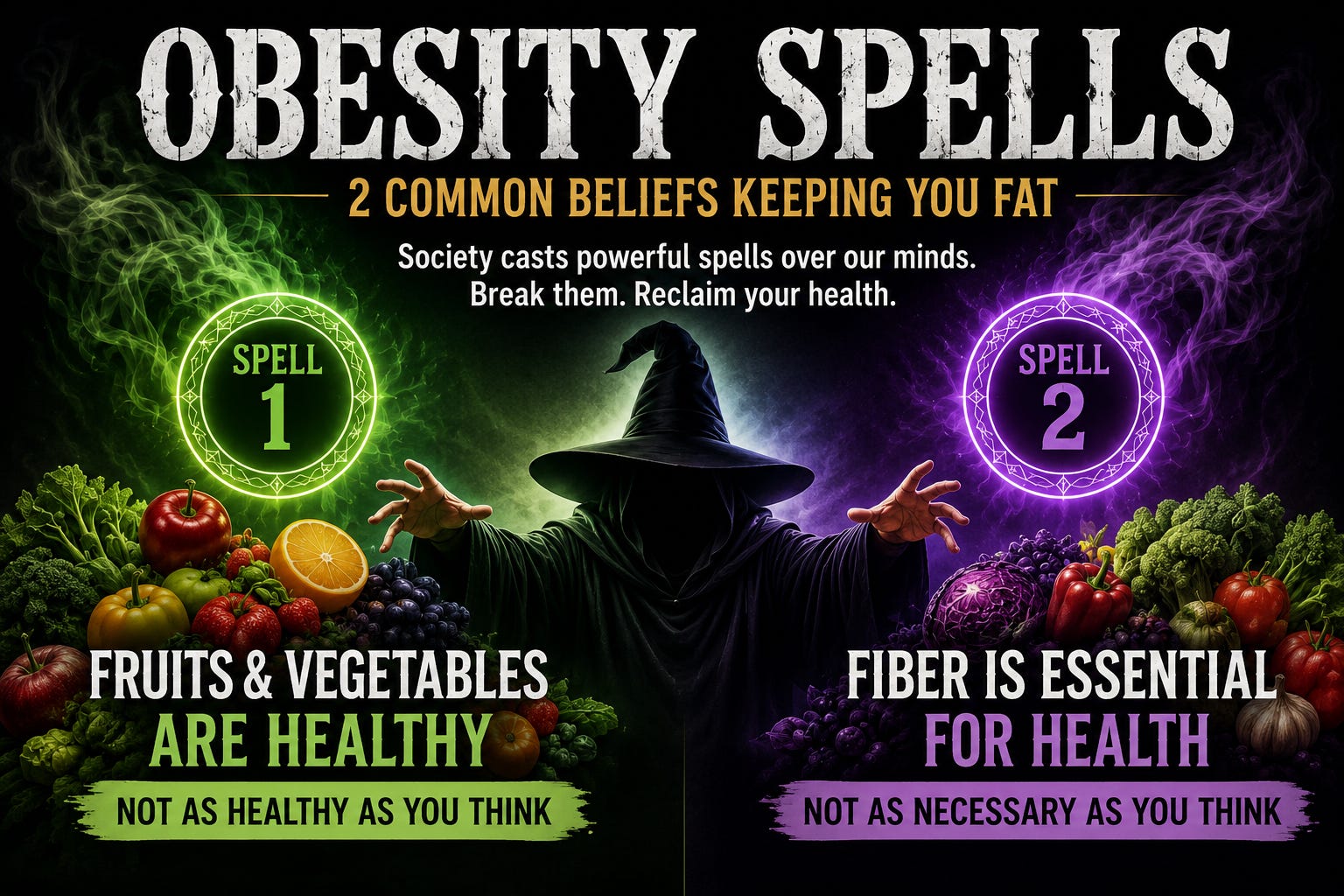
People are trapped inside nutritional “spells” — deeply repeated ideas that sound healthy simply because they’ve been repeated long enough. Many of these beliefs are not completely false. That’s what makes them powerful. They contain just enough truth to survive.
Two of the strongest obesity spells today are:
The belief that fruits and vegetables are automatically optimal foods.
The belief that fiber is universally necessary for human health.
Neither belief survives intact in the face of aging human metabolism.
As we get older, our priorities change. Muscle preservation becomes critical. Blood sugar regulation becomes more important. Recovery becomes harder. And many people discover that foods once tolerated easily at 20 begin producing brain fog, inflammation, fatigue, cravings, or digestive issues at 45.
Yet modern nutrition often continues treating all plant foods as universally protective and all fiber as universally beneficial.
Mr. Skeptical leans back in his chair.
“Funny how humans survived hundreds of thousands of years without oat bran muffins.”
He has a point.
Subconscious Fat at 10,000 feet
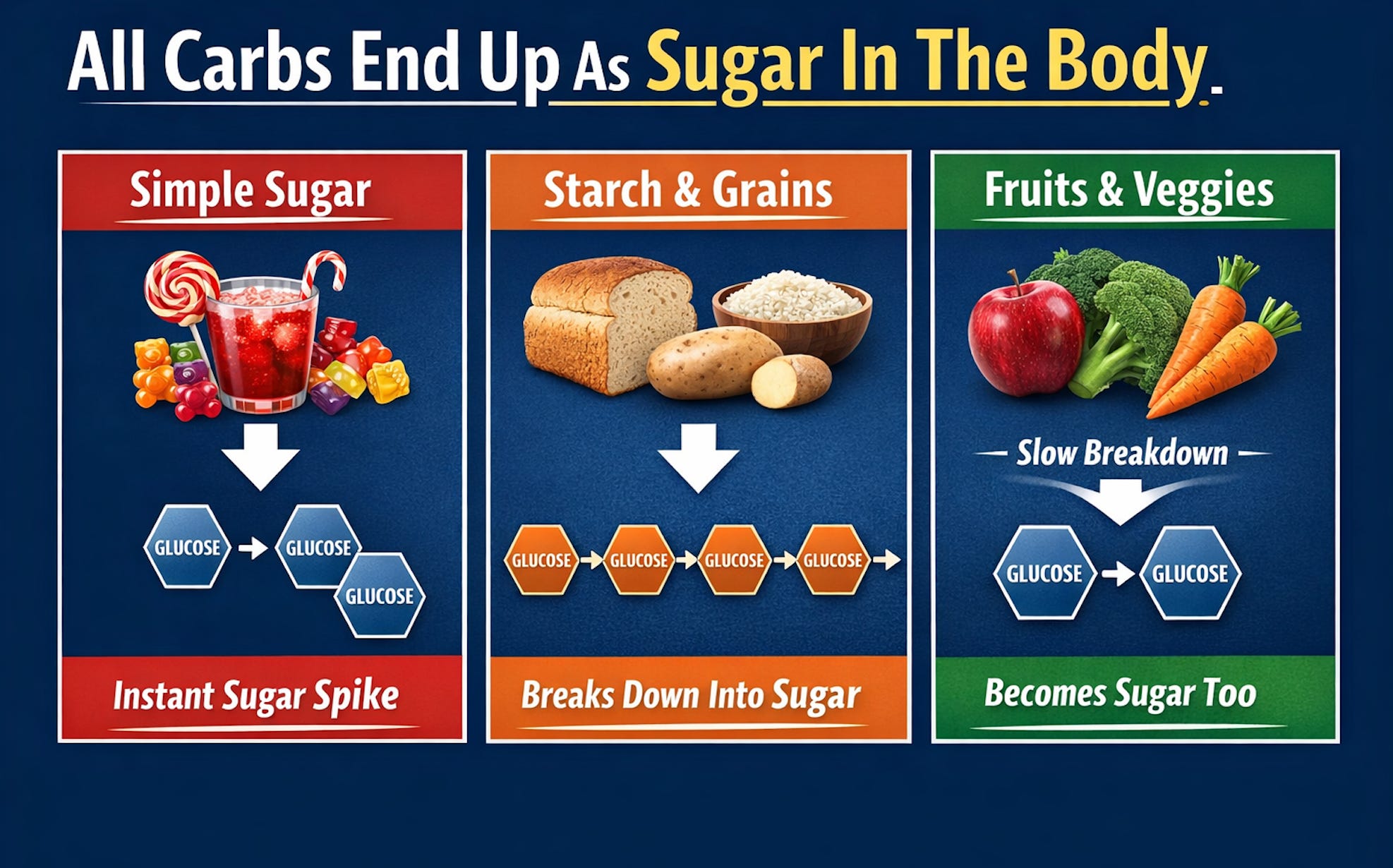
One of the strangest things about modern nutrition is how foods are often judged by isolated nutrients rather than their overall metabolic effects.
Fruit is praised for its antioxidants, vitamins, and minerals.
Vegetables are praised for their phytonutrients and fiber.
But there is another side to the equation:
Fruit still contains sugar, and vegetables still contain carbohydrates that ultimately break down into glucose.
That does not automatically make them “bad.” Context matters.
For a metabolically healthy athlete training intensely, fruit and vegetables may pose little issue.
But for many overweight, insulin-resistant adults over 40, the situation changes dramatically.
The body becomes less metabolically flexible. Muscle mass declines. Blood sugar control worsens. Cravings intensify. Energy becomes unstable.
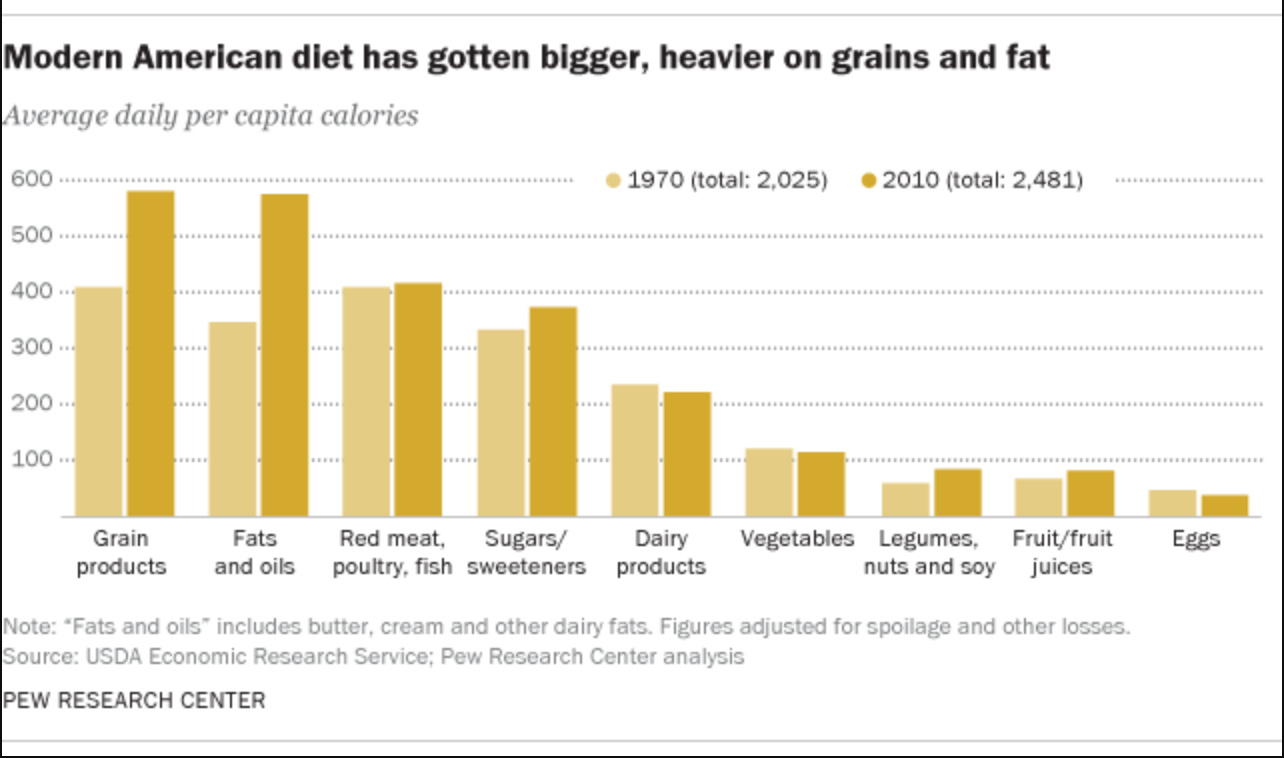
At that point, continuing to prioritize large amounts of carbohydrates — even “healthy” carbohydrates — may not be ideal.
What many people actually need is:
more protein
more nutrient density
more satiety
and better blood sugar control
In other words, they may need to shift toward a more ketogenic or carnivore-style approach.
Mr. Skeptical interrupts.
“So we spent decades telling people to fear steak… while they drank mango smoothies the size of a fire extinguisher?”
Again, difficult to argue with.
Subconscious Fat at Eye-Level
The second obesity spell is fiber.
Fiber is now treated almost like a sacred nutrient. Some people are even “fiber maxing,” attempting to consume massive amounts daily under the assumption that more is always healthier.
But many people transitioning into ketogenic or carnivore eating discover something surprising:
Once adapted to higher-fat, lower-carbohydrate intake, they often no longer need large amounts of fiber at all.
Why?
Because digestion changes.
Fat stimulates bile flow and often allows smoother digestion without relying heavily on plant bulk. Many carnivore and ketogenic eaters report reduced bloating, reduced gas, improved bowel regularity, and better satiety even with minimal fiber intake.
This sounds shocking only because modern nutrition rarely discusses the possibility that fiber requirements may depend heavily on the rest of the diet.
Fiber may be useful in high-carbohydrate diets partly because it slows glucose absorption and helps regulate appetite.
But if glucose intake is already low and insulin spikes are minimized, the body may not require the same buffering system.
That doesn’t mean everyone should eliminate vegetables tomorrow.
It means nutritional needs are not universal.
A 23-year-old athlete eating whole foods is not metabolically identical to a 52-year-old executive with chronic inflammation, low testosterone, poor sleep, and insulin resistance.
Yet nutrition advice is often delivered as if all humans were one body.
Mr. Skeptical smirks.
“Apparently, the official human diet is now: less meat, more cereal, and additional powdered fiber.”
This is getting weird. Mr. Skeptical agrees with me!
Practical Suggestions and Conclusions
The goal is not to fear plants.
The goal is to stop assuming that all “healthy foods” are equally healthy for everyone in every metabolic condition.
For many adults over 40:
prioritizing protein becomes critical
stabilizing blood sugar becomes critical
preserving muscle becomes critical
reducing cravings becomes critical
And for many, that may require reducing fruit, reducing carbohydrate intake, and moving toward a more ketogenic or carnivore-style framework.
The real obesity spell is not fruit or fiber themselves.
The real spell is the belief that modern dietary guidelines automatically reflect optimal human biology.
Sometimes the body tells a different story.
And eventually, biology always wins.
Mr. Skeptical stands up, grabs a steak from the kitchen, and shrugs.
“So after 50 years… humanity finally discovers that maybe living on cereal, juice, snack bars, and powdered fiber while fearing meat wasn’t the metabolic masterpiece we thought it was.”
Be aware.
PS Links on LinkedIn, Facebook, Instagram, X, and Notes. Full disclosure: ChatGPT was used to research and enhance this post.