

Subconscious Fat at 30,000 feet
Most of us do not have a workout problem.
We have a sitting problem.
Mr. Skeptical leans back in his chair and crosses his arms.
“A sitting problem? I’ve been sitting my entire life, and I’m still here.”
That is usually how the problem works, Mr. Skeptical.
It does not always announce itself with flashing lights and an ambulance. It quietly becomes tight hips, weaker legs, a stiff lower back, less daily movement, and a body that gradually forgets how often it was meant to change positions.
We sit while we work. We sit while we eat. We sit while we drive. We sit while we watch television. We sit while we scroll through our phones and read articles about how sitting too much is bad for us.
Then we go to the gym for 45 minutes and expect that one small window of movement to cancel out the other ten hours spent folded into a chair.
That is not how the human body was designed to operate.
The body adapts to whatever we repeatedly ask it to do. If we spend most of the day sitting, the body becomes exceptionally skilled at sitting. The hips stay bent. The glutes become passengers. The legs do less work. The lower back absorbs more of the load.
The solution does not have to be complicated.
Sometimes, we simply need to stand up.

Subconscious Fat at 10,000 feet
I have started bringing what I call stand-up energy into my podcast interviews.
Instead of sitting in a chair and slowly sinking into the conversation, I stand. I demand my guests on the podcast to do the same.
The difference is noticeable.
When people stand, they often speak with more energy. Their posture improves. Their breathing feels less restricted. The conversation can feel more active and less like two people holding a business meeting inside a waiting room.
I have also started experimenting with this during Zoom calls with some of my fitness clients.
Not necessarily for the entire meeting. Not as punishment. Not because sitting is forbidden.
But because many people have already been sitting for hours before the call begins.
Mr. Skeptical slowly rolls his office chair backward.
“So now I have to stand during meetings too? Is nothing sacred anymore?”
You are allowed to sit, Mr. Skeptical.
The idea is not that sitting is evil. The problem is that sitting has become the default position for nearly everything we do.
Standing simply gives the body another option.
Subconscious Fat at Eye-Level
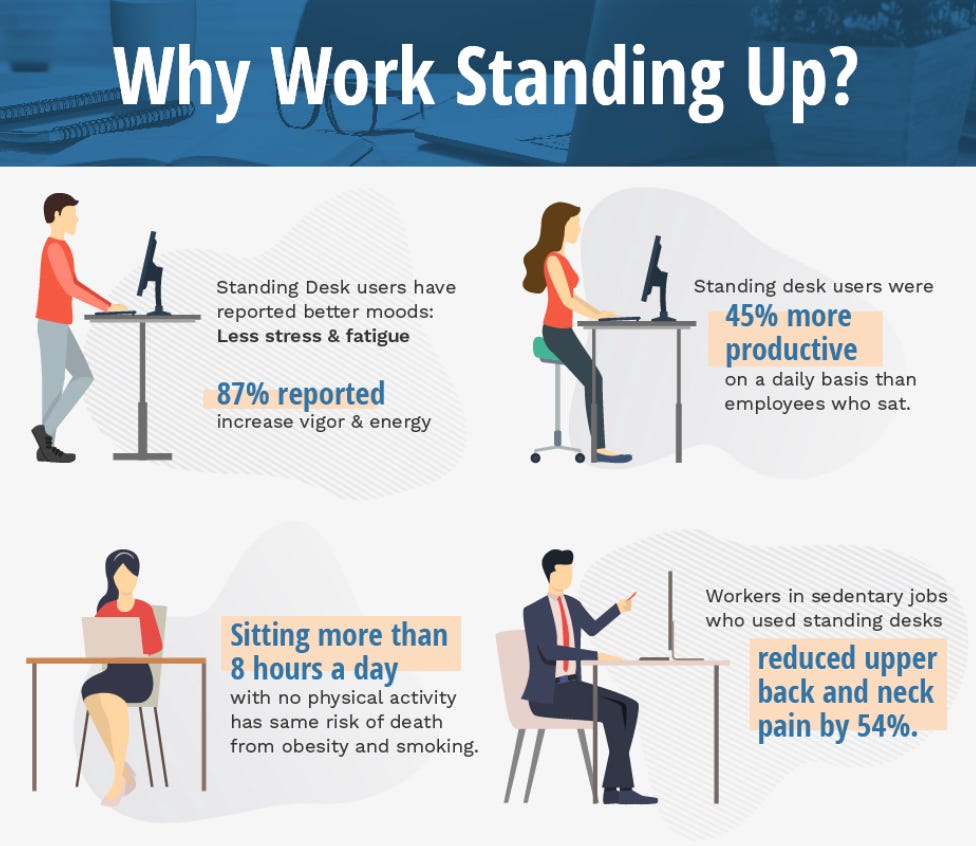
One of the easiest changes is to create a standing workspace.
That could mean purchasing a proper sit-stand desk. But it does not have to mean buying expensive equipment.
You can place your laptop on a sturdy platform, shelf, dresser, countertop, or raised surface. The screen should be high enough that you are not bending your neck downward for hours.
The goal is not to stand rigidly like a soldier.
The goal is to change positions.
Stand for a while. Shift your weight. Take a few steps. Lean lightly against the desk. Then sit when your body needs a break.
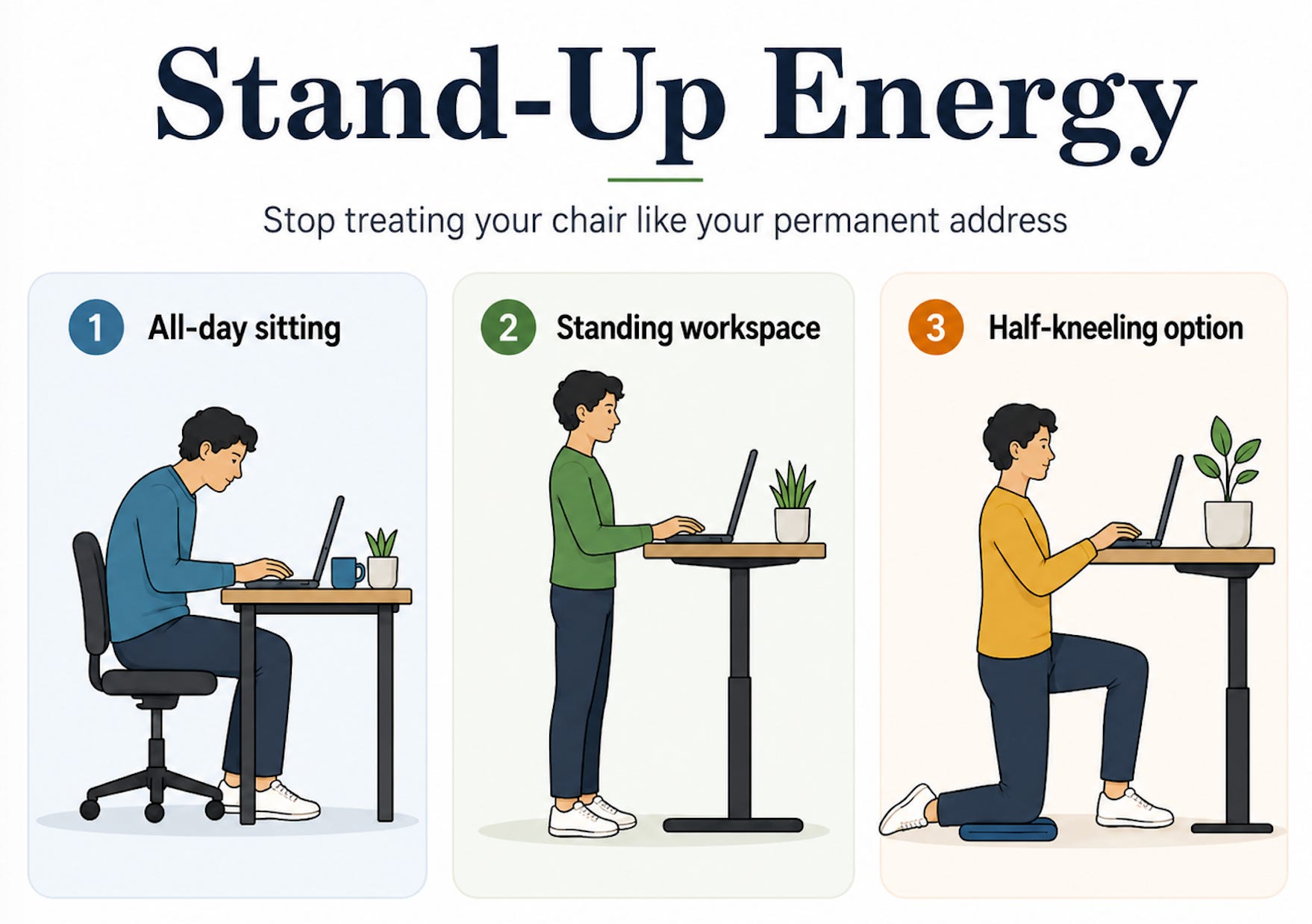
Another position I use is half-kneeling—down on one knee with the other foot planted in front.
This can be a useful alternative when I do not want to sit, but I also do not want to stand continuously.
I may place a folded towel, cushion, or even a flip-flop under the kneeling knee for comfort. After a few minutes, I switch sides.
This distributes the load differently through the hips and legs rather than keeping all the pressure concentrated in the same seated position and lower-back posture.
Mr. Skeptical examines the flip-flop under my knee.
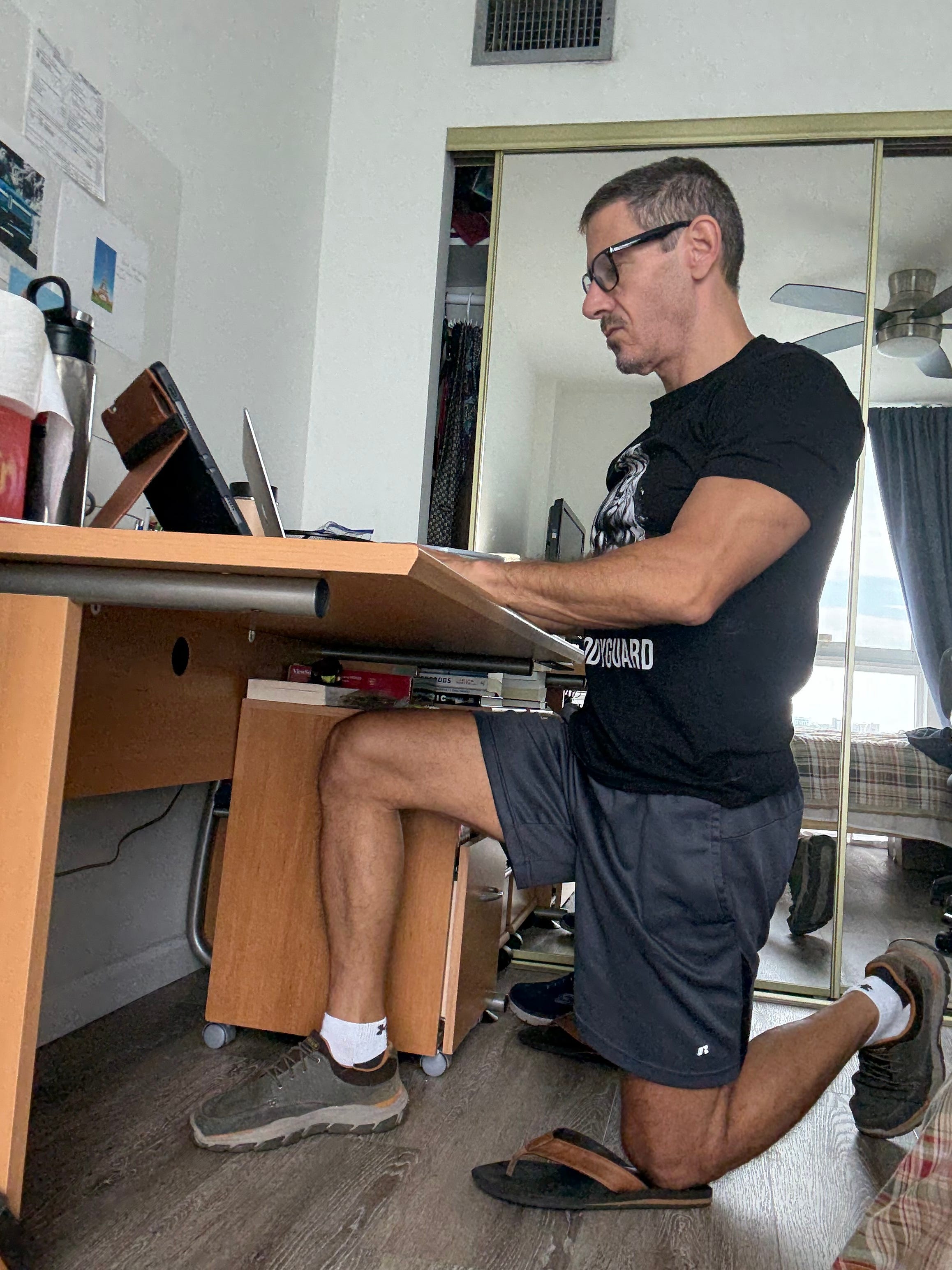
“You built a fitness system out of office furniture and beach footwear?”
Sometimes the simplest tools are the ones people actually use.
Half-kneeling also exposes imbalances. One side may feel stable while the other side feels awkward or tight. That information can be useful. The body often tells us where we have lost mobility or control—provided we place it in positions that allow it to speak.
Practical Suggestions and Conclusions
You do not need to throw away every chair in your home.
You simply need to stop treating the chair as your permanent address.
Try alternating positions throughout the day:
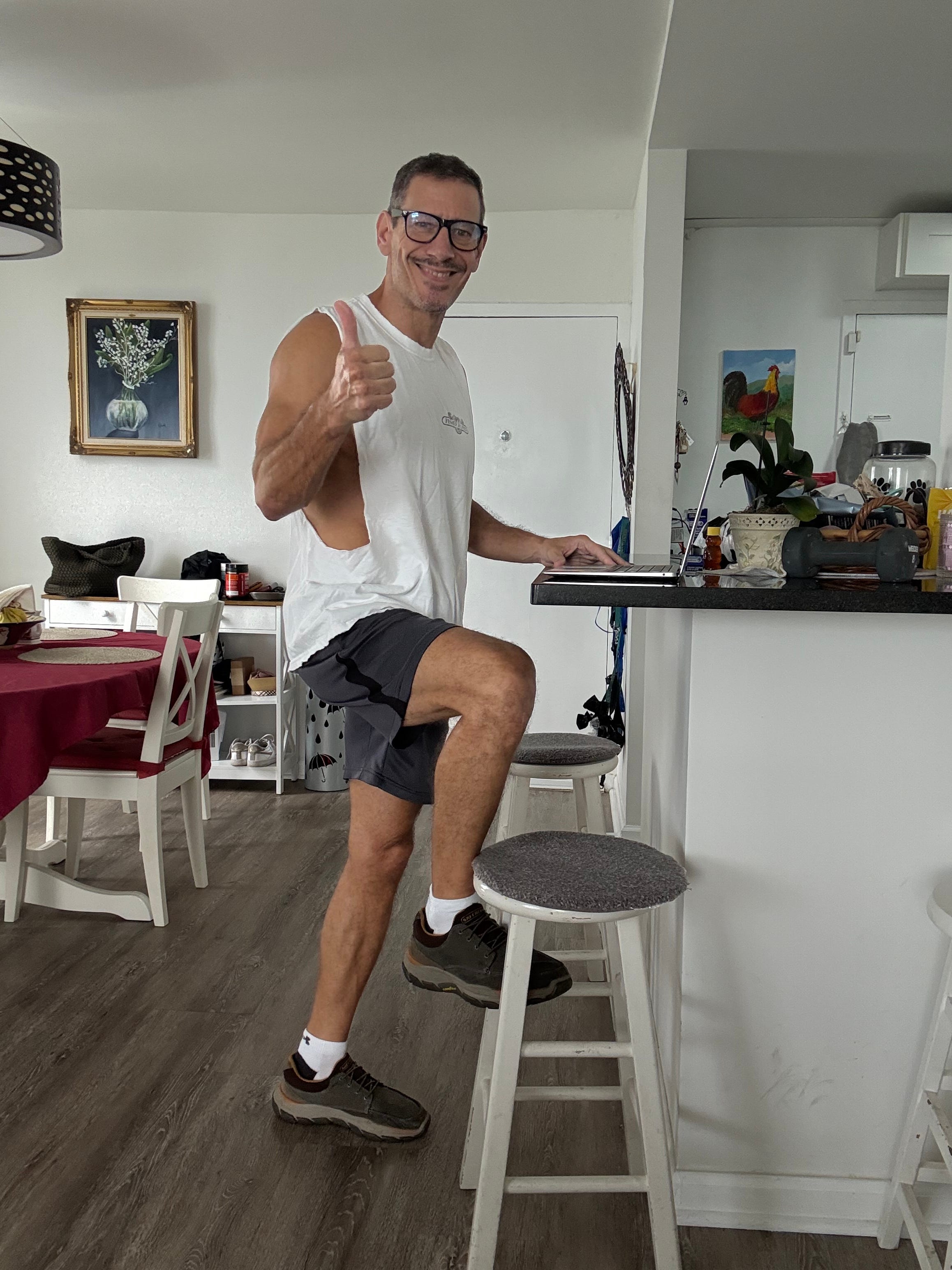
Stand while taking phone calls.
Raise your computer for part of your workday.
Conduct part of your next Zoom meeting standing.
Use a half-kneeling position for a few minutes, then switch knees.
Walk around during conversations that do not require you to look at a screen.
And when you sit, sit intentionally. Do not collapse into the chair and remain there until bedtime.
Movement does not only happen during exercise.
Movement is also the small decision to change position, use your legs, support your own body weight, and avoid remaining frozen in one posture for hours.
That is what stand-up energy is really about.
It is not about trying to turn every meeting into a workout.
It is about remembering that the human body was built to move—even while the rest of the world keeps offering us another chair.
Be aware.
Other links related to this post:
PS Links on LinkedIn, Facebook, Instagram, X, and Notes.
Full disclosure: ChatGPT was used to research and enhance this post.