

Subconscious Fat at 30,000 Feet
Imagine two men.
One weighs 190 pounds with a 32-inch waist.
The other also weighs 190 pounds, but his waist measures 42 inches.
The bathroom scale says they’re identical.
Your body says otherwise.
What if I told you that one of the simplest ways to estimate your metabolic health doesn’t require a doctor’s appointment, a blood test, or even a scale?
All you need is a tape measure.
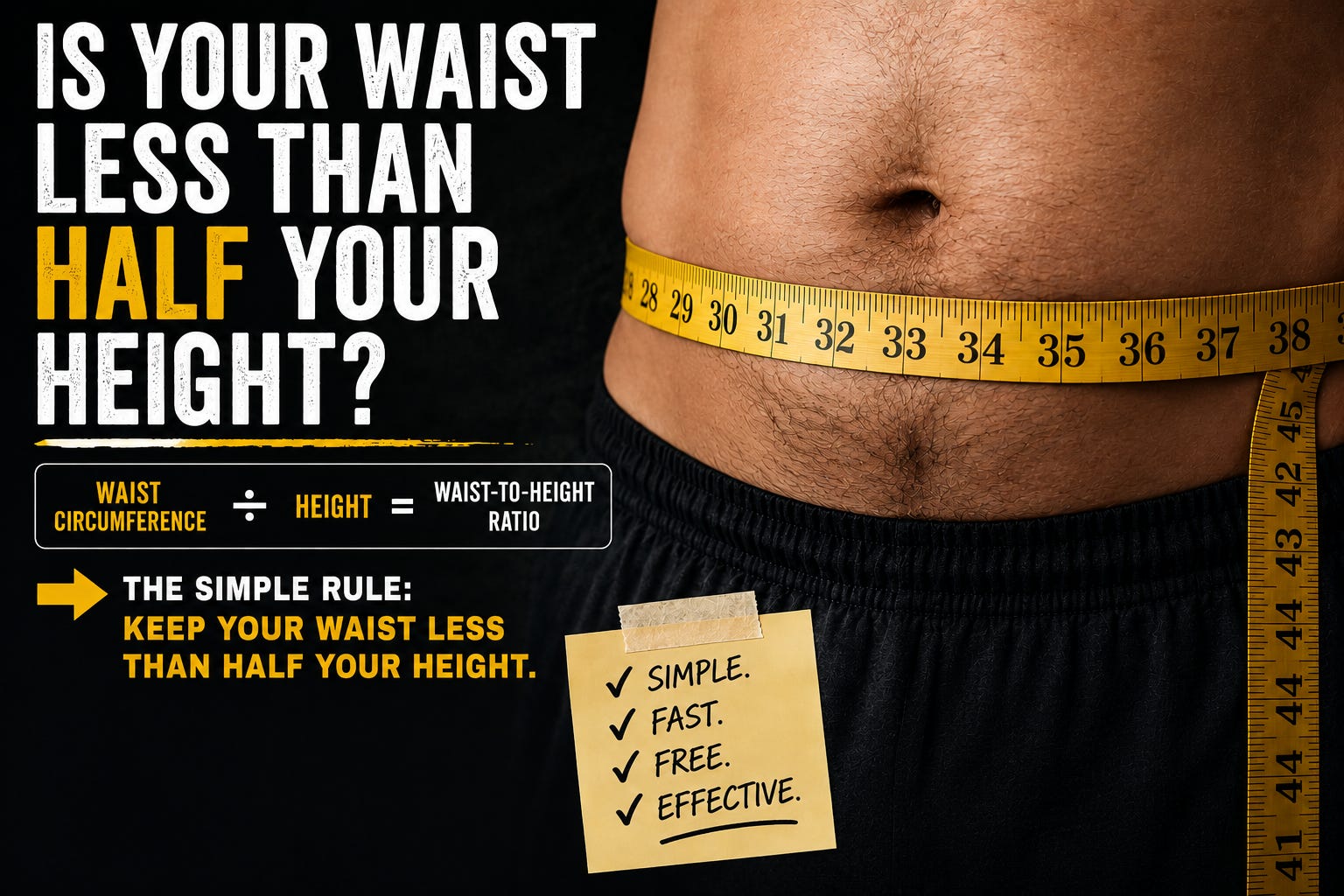
The measurement is called the waist-to-height ratio (WHtR).
The formula couldn’t be simpler:
Waist Circumference ÷ Height = Waist-to-Height Ratio
Fortunately, you don’t even have to remember the math.
Just remember one rule:
Keep your waist less than half your height.
If you’re 6 feet tall (72 inches), aim for a waist under 36 inches.
If you’re 5’10” (70 inches), aim for under 35 inches.
If you’re 5’8” (68 inches), aim for under 34 inches.
That’s it.
Mr. Skeptical scratches his head.
“Wait a second...you’re telling me a $5 tape measure might tell me something important about my health?”
It just might.
Sometimes the simplest measurements are the ones we’ve ignored while chasing more complicated ones.

Kevin Spencer Beckford is the Managing Principal of Finding Your Cup LLC and a strategic leadership consultant with more than 30 years of experience across financial services, healthcare, higher education, technology, government, and nonprofit organizations. He helps leaders improve organizational performance, develop stronger teams, and lead lasting change. Kevin also made history as the first African American elected to the Pittsford, New York Town Board and remains an active civic leader dedicated to serving his community.
Kevin.Beckford@me.com ph. (585) 747-4354 LinkedIn profile
Kevin will be my guest on The Better Wealth and Health Podcast, dropping tomorrow at 11:57 a.m. Eastern.
Subconscious Fat at 10,000 Feet
For years we’ve been obsessed with body weight.
Then BMI became the gold standard.
The problem?
BMI has no idea whether those pounds come from muscle or fat.
A muscular football player and a sedentary office worker can have exactly the same BMI while looking nothing alike.
The waist-to-height ratio asks a much better question:
How much of your body is your waist taking up?
Why does that matter?
Because fat stored around the abdomen is associated with a greater risk of metabolic disease than fat stored in many other places.
A larger waist often reflects more visceral fat—the fat surrounding your organs—which has been linked with conditions like Type 2 diabetes, high blood pressure, heart disease, and metabolic dysfunction.
Now, before anyone misunderstands me...
I’m not saying a tape measure replaces your doctor.
Blood pressure still matters.
Blood sugar still matters.
Blood work still matters.
But if someone asked me, “You can only measure one thing today,” I’d be pretty happy with that choice.
Mr. Skeptical raises an eyebrow.
“So should I throw away my lab results?”
Not at all.
Think of your waist measurement as one of the easiest health screenings you’ll ever perform.
No appointment.
No waiting room.
No needle.
Just honesty.
Subconscious Fat at Eye-Level
Here’s how simple it is.
Stand up.
Relax.
Don’t suck your stomach in.
Measure your waist about halfway between the bottom of your ribs and the top of your hips, usually just above your belly button.
Then measure your height.
Use the same units for both.
Now divide:
Waist ÷ Height
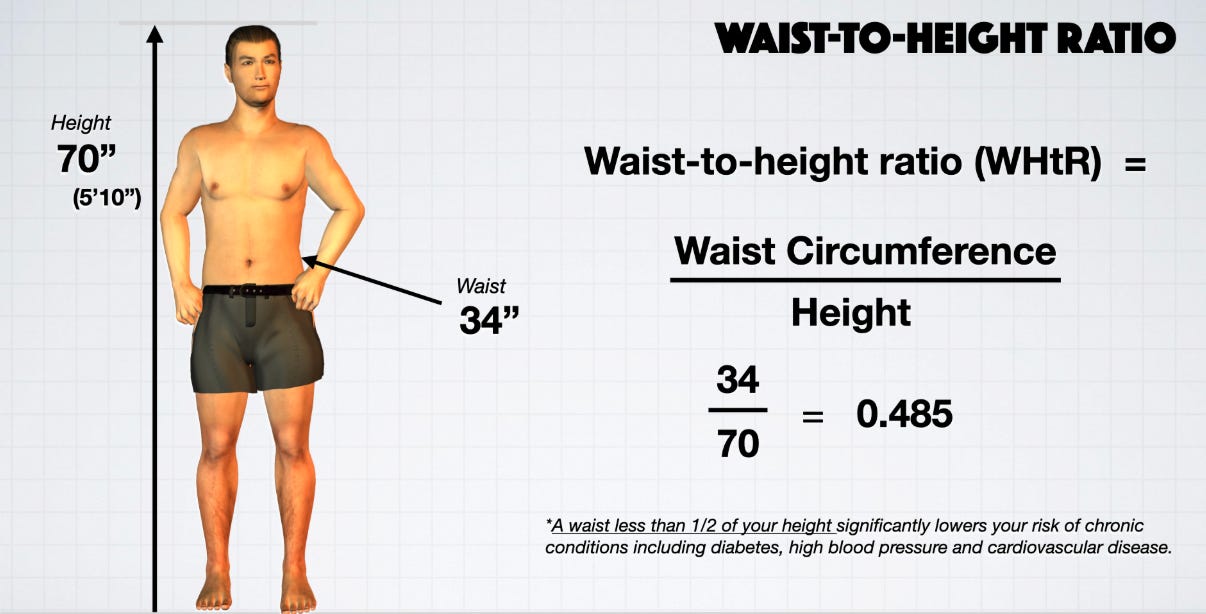
Let’s say you’re 5’10”.
That’s 70 inches.
If your waist is 38 inches...
38 ÷ 70 = 0.54
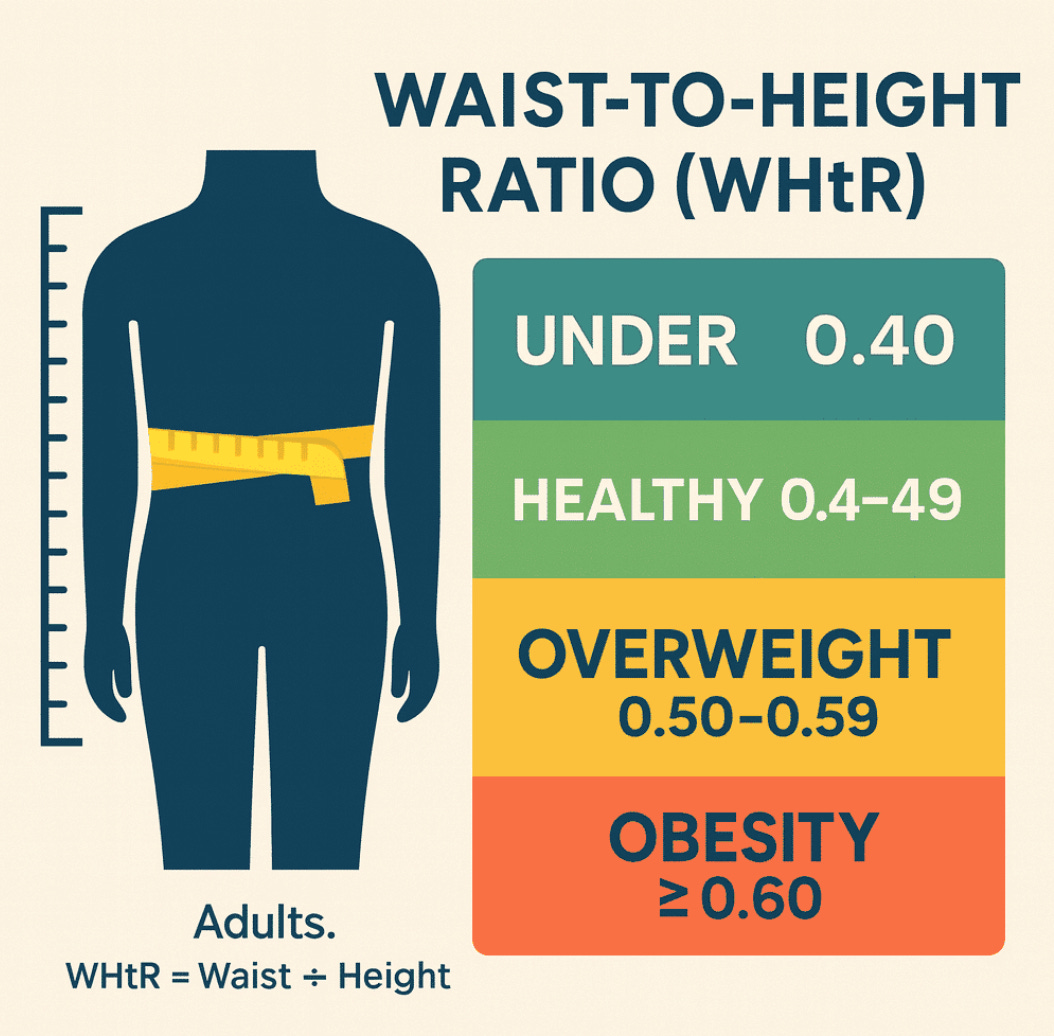
That’s above the commonly recommended target of 0.50.
Now imagine you lose a few inches around your waist.
Your waist drops to 34 inches.
34 ÷ 70 = 0.49
You didn’t grow taller.
You didn’t necessarily lose a massive amount of body weight.
But your health profile improved substantially.
People often confuse this with the waist-to-hip ratio, which compares your waist to your hips.
That measurement has value too.
But I like the waist-to-height ratio because anyone can remember it:
Your waist should be less than half your height.
No complicated charts.
No confusing formulas.
Just one memorable rule.
Mr. Skeptical smiles.
“So my plan to improve my ratio by getting four inches taller probably isn’t going to work?”
Probably not.
Working on your waist is the easier option.
Practical Suggestions and Conclusions
Tomorrow morning, before breakfast, grab a tape measure.
Measure your height.
Measure your waist.
Divide one by the other.
That’s your waist-to-height ratio.
If your waist is less than half your height, congratulations.
You’re meeting one of the simplest benchmarks associated with lower health risk.
If you’re above that mark, don’t panic.
Don’t starve yourself.
Don’t spend thousands chasing the latest biohack.
Instead, use it as feedback.
Build muscle.
Eat foods (like animal products with their natural fat) that help control your appetite.
Sleep well.
Reduce excess body fat.
Then measure again in a month.
One of the mistakes we make is believing that health has to be incredibly complicated.
We buy expensive gadgets.
We obsess over tiny laboratory changes.
We track dozens of biomarkers.
Meanwhile, one of the most useful health measurements may be sitting in the junk drawer in your kitchen.
A tape measure.
Mr. Skeptical sighs.
“I was really hoping you’d tell me buying a smarter smartwatch would shrink my waist.”
Sorry.
Your watch isn’t getting fatter.
Your waistband is.
Start with the tape measure.
The smartwatch can wait.
Be aware.
Other links related to this post:
PS Links on LinkedIn, Facebook, Instagram, X, and Notes.
Full disclosure: ChatGPT was used to research and enhance this post.
🎙️The Better Wealth & Health Podcast with guest Kevin Spencer Beckford is dropping tomorrow at 11:57 AM Eastern.