

Subconscious Fat at 30,000 feet
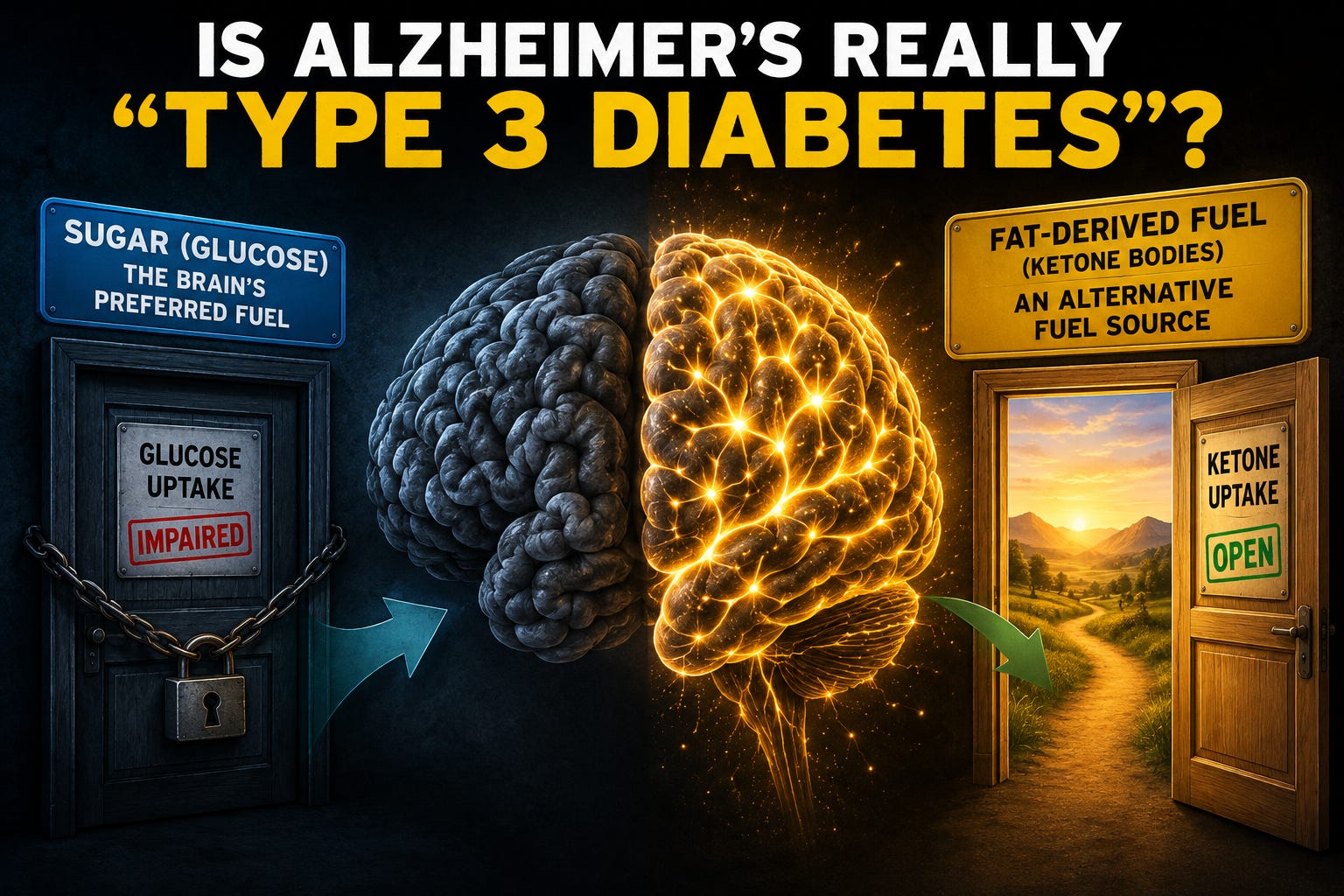
Imagine having a refrigerator full of food—but being unable to open the door.
You aren’t starving because food doesn’t exist.
You’re starving because you can’t properly access it.
Something similar may be happening inside the brain in Alzheimer’s disease.
For decades, Alzheimer’s has primarily been discussed in terms of amyloid plaques and tau proteins. But another theory has been developing alongside it:
What if Alzheimer’s is also a metabolic disease?
Mr. Skeptical raises an eyebrow.
“Wait. Are you telling me Alzheimer’s is diabetes?”
This is where ChatGPT tells me to say ‘Not exactly.’ But in my opinion, diabetes is the underlying Subconscious Fat to many diseases, including Alzheimer’s disease.
And some way more credentialed researchers than me have gone far enough to call Alzheimer’s “Type 3 diabetes.”
And that changes the conversation.

Russell “Russ” Eakle is a Cleveland-based professional voice actor, mentor, and founder of Valiant Voice Of An Era. His voice work spans commercials, animation, audiobooks, narration, character roles, and digital media, including work connected with brands and productions such as LEGO.
Russell’s path into voice acting began during a serious health challenge, when he became determined to create something lasting and meaningful for his son. Now in good health and working full-time in the craft, Russell brings versatility, emotion, and storytelling to his performances while also mentoring others pursuing careers in voice acting.
ValiantVoiceOfAnEra.com ph. 440-570-4357
Join Russell and me for another conversation with Stand-Up Energy on The Better Wealth and Health Podcast. 🎙️ New episode drops tomorrow, Friday, at 11:57 a.m. ET
Subconscious Fat at 10,000 feet
The term isn’t something invented by a TikTok influencer.
In 2008, Brown University researcher Dr. Suzanne de la Monte and Dr. Jack Wands published a scientific review literally titled Alzheimer’s Disease Is Type 3 Diabetes—Evidence Reviewed.
Their argument centered on abnormalities in insulin signaling and glucose metabolism inside the Alzheimer’s brain. Later research from de la Monte continued describing Alzheimer’s as potentially representing a brain-specific form of diabetes.
Neurologist Dr. David Perlmutter, author of Grain Brain, has also popularized the connection between insulin resistance, metabolic dysfunction and Alzheimer’s.
And psychiatrist Dr. Georgia Ede, author of Change Your Diet, Change Your Mind, (link for my book review below) focuses much of her work on the relationship between metabolism, nutrition and brain health. She has discussed Alzheimer’s in terms of impaired brain glucose processing and insulin resistance.
Mr. Skeptical interrupts.
“Okay, but the brain needs glucose. Doesn’t it?”
Yes.
But here’s where things get really interesting.
Subconscious Fat at Eye-Level
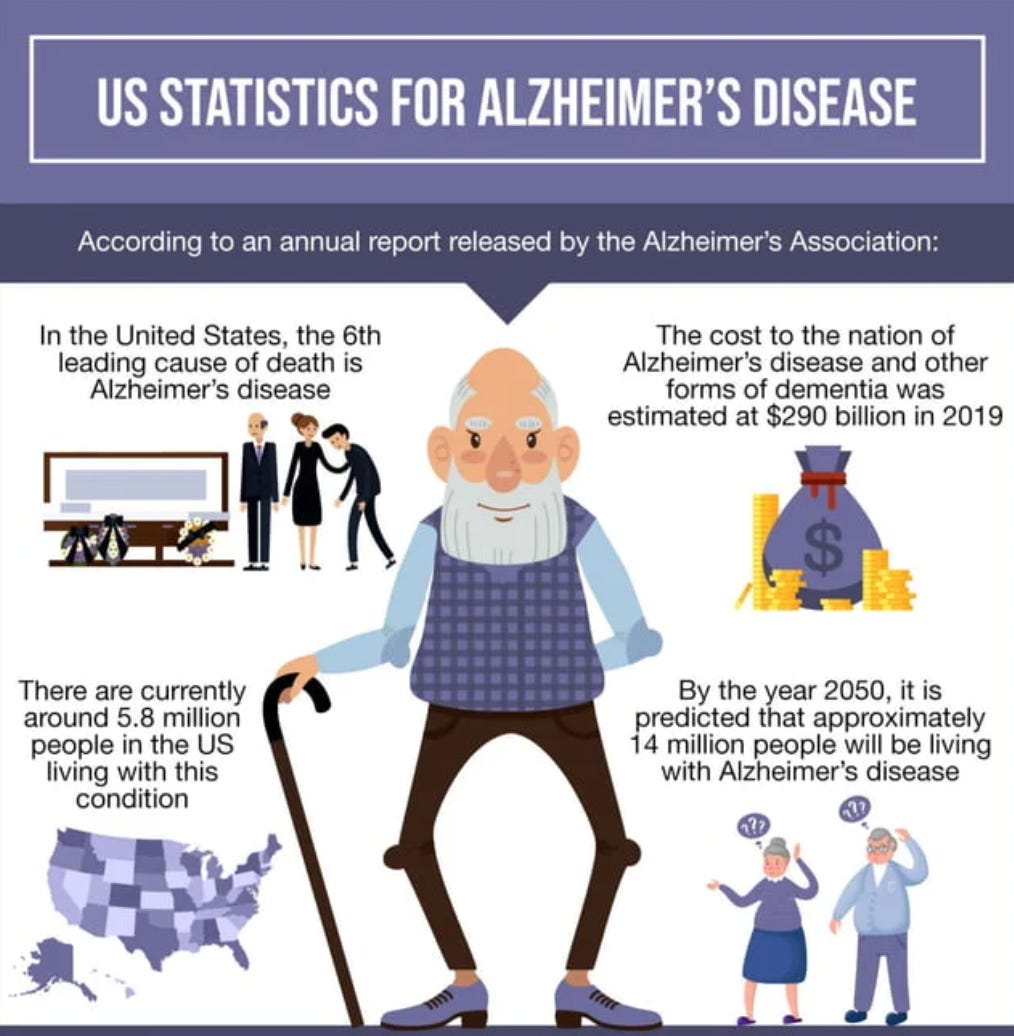
The brain is an energy hog.
Under normal circumstances, glucose supplies most of its energy.
But Alzheimer’s brains show impaired glucose uptake and metabolism in important regions.
Researchers led by Dr. Stephen Cunnane have studied another remarkable finding:
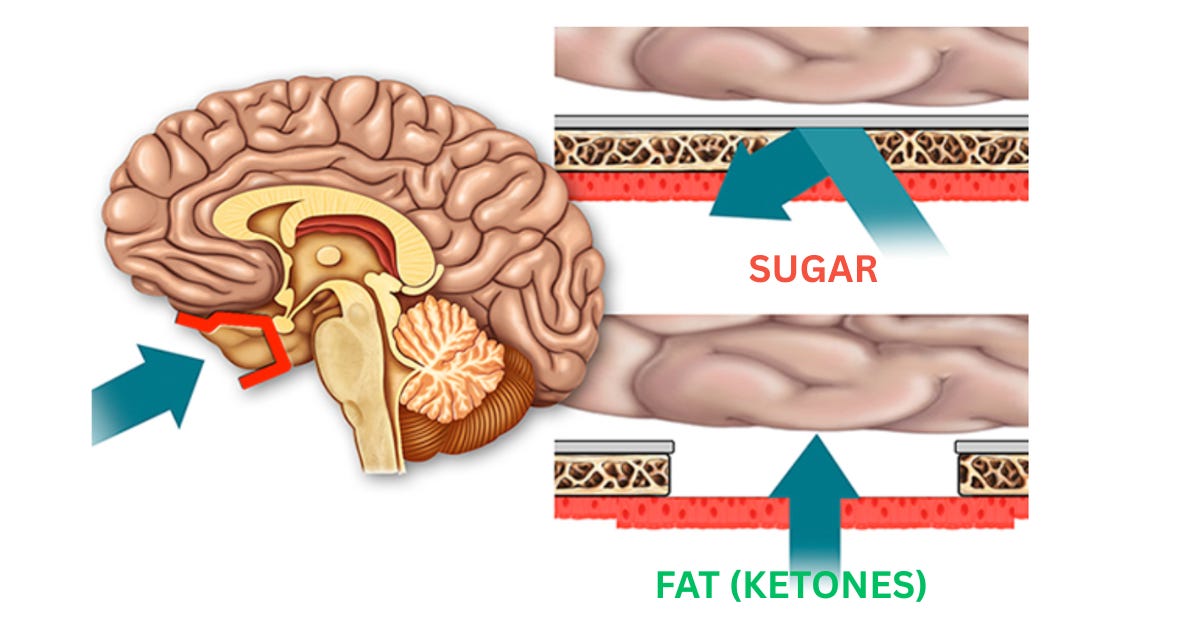
While the Alzheimer’s brain’s ability to use glucose declines, its ability to take up ketones can remain relatively intact.
So what exactly are ketones?
Ketones are an alternative fuel produced by your liver from fat when carbohydrate availability is low. When someone dramatically reduces carbohydrates—as with a ketogenic or carnivore-style diet emphasizing foods such as meat, eggs, fish and animal fats—or during periods of fasting, the body begins relying more heavily on fat for energy. The liver converts some of that fat into ketones, which can then be used as fuel by the body and brain.
And here’s the fascinating part:
Ketones can cross the blood-brain barrier and provide neurons with an alternative source of energy.
Think about our refrigerator again.
One fuel door isn’t opening properly.
But another one still is.
Cunnane’s research has investigated whether supplying more ketones might partially bypass the brain’s glucose-energy deficit. Clinical studies have reported modest improvements in certain cognitive outcomes in people with mild cognitive impairment or mild-to-moderate Alzheimer’s, although this remains an active area of research—not a proven cure.
And here is where I’d wish ChatGPT would tell me something more authentic and real, as there will likely NEVER be research on this because who’s going to fund it?
Not pharmaceutical companies.
Maybe one day, meat, chicken, and fish processing companies will get together and fund it; that would actually be a great idea.
Mr. Skeptical leans forward.
“So ketogenic diets cure Alzheimer’s?”
No. But the metabolic question deserves serious attention.
Again, the above is what ChatGPT is telling me to say, but I really believe that, in most cases, an animal-based diet can have a huge impact on Alzheimer’s.
Practical Suggestions and Conclusions
“Type 3 diabetes” is not an official medical diagnosis, and Alzheimer’s is enormously complex. Genetics, aging, vascular health, inflammation, amyloid, tau and other mechanisms can all play roles.
But dismissing metabolism would be equally foolish.
Actually, really foolish.
If insulin resistance and impaired glucose metabolism contribute to Alzheimer’s—and evidence increasingly supports an important connection—then protecting metabolic health also means protecting brain health. Duh!
That makes the fundamentals remarkably important:
Maintain and grow muscle.
Protect your sleep.
Avoid chronically elevated blood glucose and insulin.
Prioritize nutrient-dense animal-based foods.
And perhaps most fascinatingly, continue watching the research into ketones as an alternative brain fuel.
Really, ChatGPT?
Like we all have time to just sit around and wait for the latest research on metabolic brain health.
Because Alzheimer’s may not simply be a disease where the brain forgets.
It may also be a disease where parts of the brain are slowly losing their ability to properly fuel themselves.
And if that’s true, perhaps one of the biggest questions in Alzheimer’s research shouldn’t only be:
How do we remove what’s accumulating in the brain?
Maybe we should also be asking:
What are we feeding it?
Be aware.
Other links related to this post:
PS Links on LinkedIn, Facebook, Instagram, X, and Notes.
Full disclosure: ChatGPT was used to research and enhance this post.
🎙️The Better Wealth & Health Podcast with guest Russell Eakle is dropping tomorrow at 11:57 AM Eastern.
Doing a live banded workout event on Saturday, October 3rd at Legions Park in Miami, details coming soon.
Good to know. Thanks